
I was set a challenge and it was a tough one for a few reasons
I’m a firm believer in revisiting the same location multiple times because the weather and the light will always change, and when you add seascape photography into the mix, you also have the tides to consider. A location can look completely different depending on the time of day, the weather conditions and where the tide happens to be, which is why I never really feel that you can photograph somewhere once and say that you have completely explored it. At the same time, I’m also a big believer in getting out and exploring somewhere new because there is something different about arriving at a location for the first time and having to work everything out as you go.
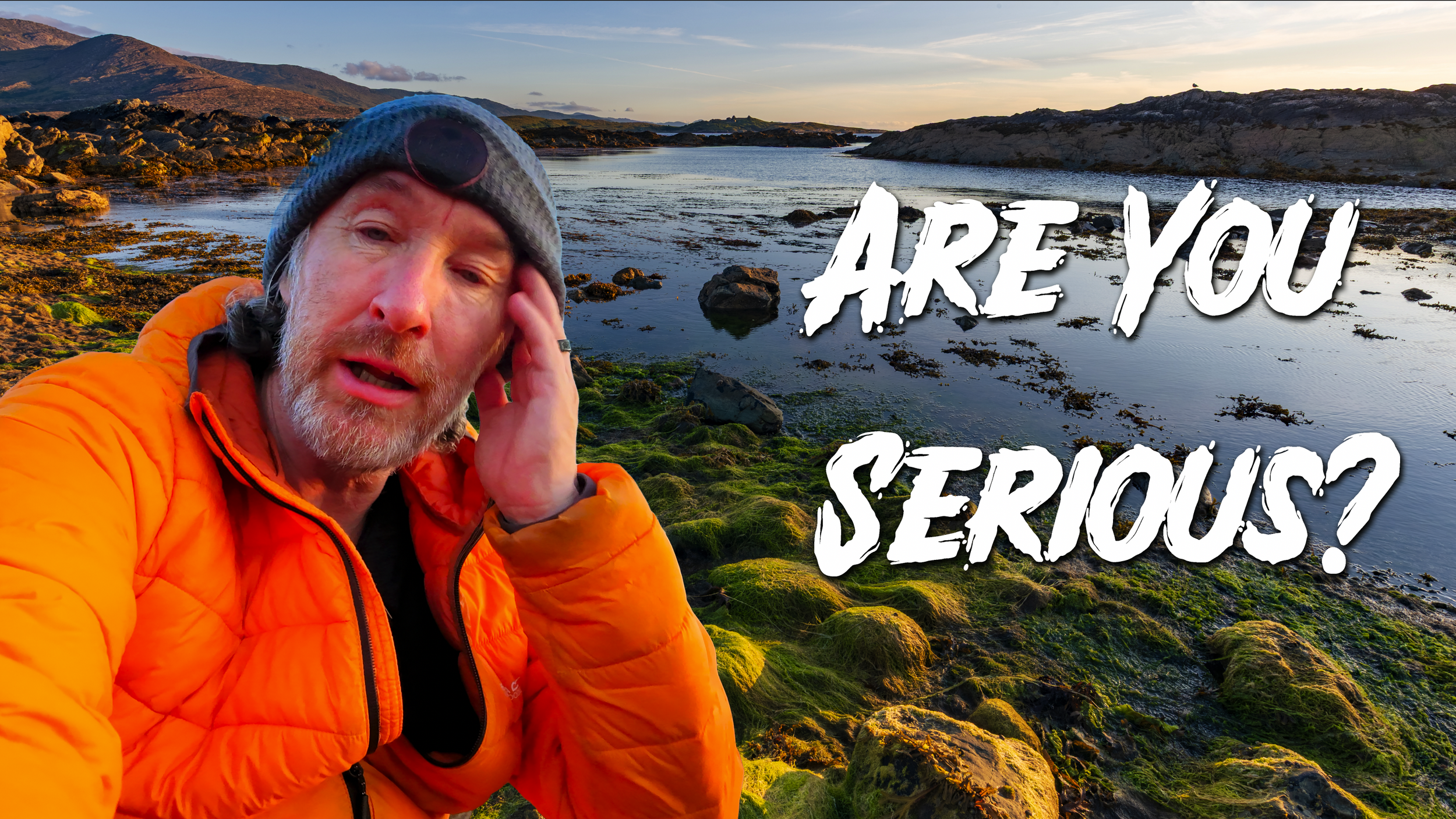
That was the situation I found myself in on this particular evening. I was visiting my friend Robert in Kenmare when he mentioned a location that he thought I should go and visit, as he felt it was somewhere I would really enjoy photographing. I took a quick look at the location and decided that I would head over there for sunset. I had never been there before, so I had no idea exactly what I would find or what compositions might be available. I wasn’t arriving with a particular image in my head that I wanted to recreate, which meant I would have to explore the location and see what it gave me when I arrived.
Even the drive there was giving me an indication that this was a part of Ireland I had not really experienced before. As I continued along the road, I was taking in the landscape around me while also keeping an eye on the time because I wanted to arrive with enough time to find a composition before the light started to change. When I got closer to the location, however, I realised that the tide was going to be low, and that was potentially going to make things more difficult.
Anyone who photographs the coast will know how much of an impact the tide can have on a location. It can completely change the foreground, expose rocks that would normally be underwater, create or remove rock pools and alter the way water moves through the scene. In this case, the low tide had exposed a large number of rocks, but there was an immediate problem for me because many of them were covered in green seaweed and algae. It wasn’t necessarily something that I would normally look at and think, that is going to make a good landscape photograph, so I was going to have to work a little harder to find something that interested me.
There was also another thought sitting in the back of my mind as I arrived. A couple of months earlier, my friend Gavin had challenged me not to use my 10-stop filter for ten months. Of course, the problem with Gavin’s challenge was that I don’t use a 10-stop filter anymore. In fact, I hadn’t used one at all during 2026, so technically his challenge wasn’t really going to change the way I photograph anyway. But it had stayed in the back of my mind, and as I started looking around this new location, I did wonder whether this might be the shoot where I would deliberately avoid using any filters at all.

It didn’t take long before I realised that the location itself was probably going to make that decision for me. I started exploring the exposed rocks, looking for something that would give me a strong composition, but initially I struggled to find anything that really worked. I couldn’t see an obvious leading line, and the foreground wasn’t giving me the sort of structure that I would normally look for. I was beginning to wonder whether I had arrived at the wrong point of the tide, but then I noticed what the evening light was doing to the algae.
The sunlight was hitting the green seaweed-covered rocks and they were starting to glow. That immediately changed how I looked at the scene because rather than treating the algae as something that was getting in the way of the photograph, I started to see it as the subject. This is one of the things I enjoy about arriving somewhere new. You can have an idea of what you expect to photograph, but the location doesn’t have to give you that image. Sometimes you have to forget about what you thought you were going to photograph and start looking at what is actually happening in front of you.
The problem was that the light was changing very quickly. There was a rock ridge directly in front of me and the sun was getting lower behind it. I knew that once the sun dropped behind the ridge, the direct light would disappear from the algae and the reason I had started to find the scene interesting would be gone. I didn’t have time to spend ages working through different compositions, so I quickly set up the camera and framed the shot.
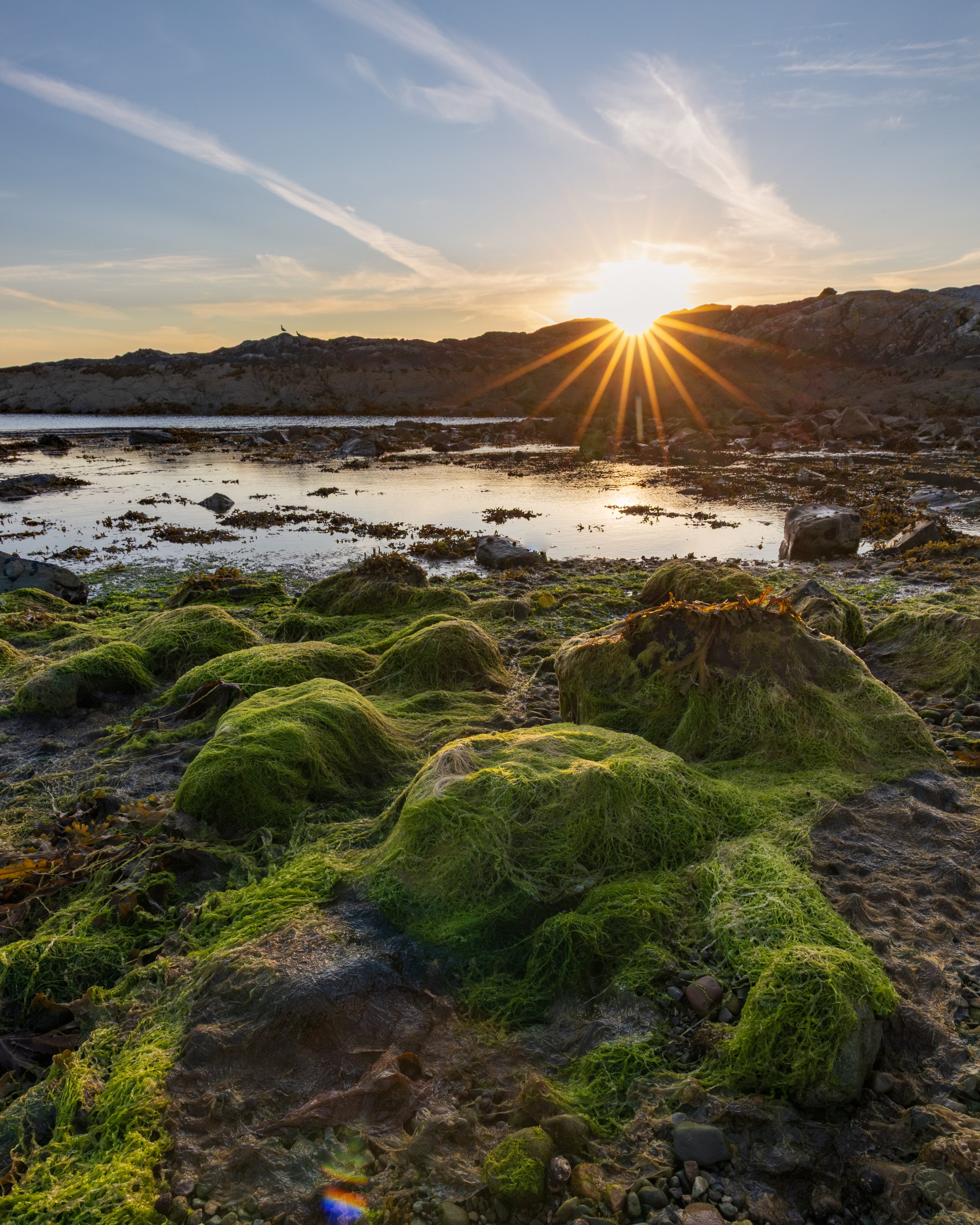
The timing was good because the sunlight was still hitting the algae-covered rocks while the sun was just visible above the top of the ridge. That gave me the opportunity to include a sun star in the photograph, so I stopped the camera down to f/6, framed everything up and took the first shot. There were no filters involved, which meant that Gavin’s challenge was already sitting quietly in the back of my mind as I started the shoot.
Once I had that first photograph, I started moving around the area to see what else I could find. There were more rocks covered in the same green algae, and as the sun continued to drop, the light was moving across the landscape. I found myself having to move backwards to keep the sunlight on the subject because the area being illuminated was gradually getting smaller. It is something that can be easy to forget when you are photographing sunset because we often think about the light simply getting darker, but the direction and angle of the light are changing constantly as well.
That meant that I couldn’t simply find a composition and stay there for the rest of the evening. I had to keep watching what the light was doing and adjust my position accordingly. A composition that worked a few minutes earlier could quickly lose the light that made it interesting, so I continued exploring and looking for other possibilities while keeping an eye on what was happening in the sky.
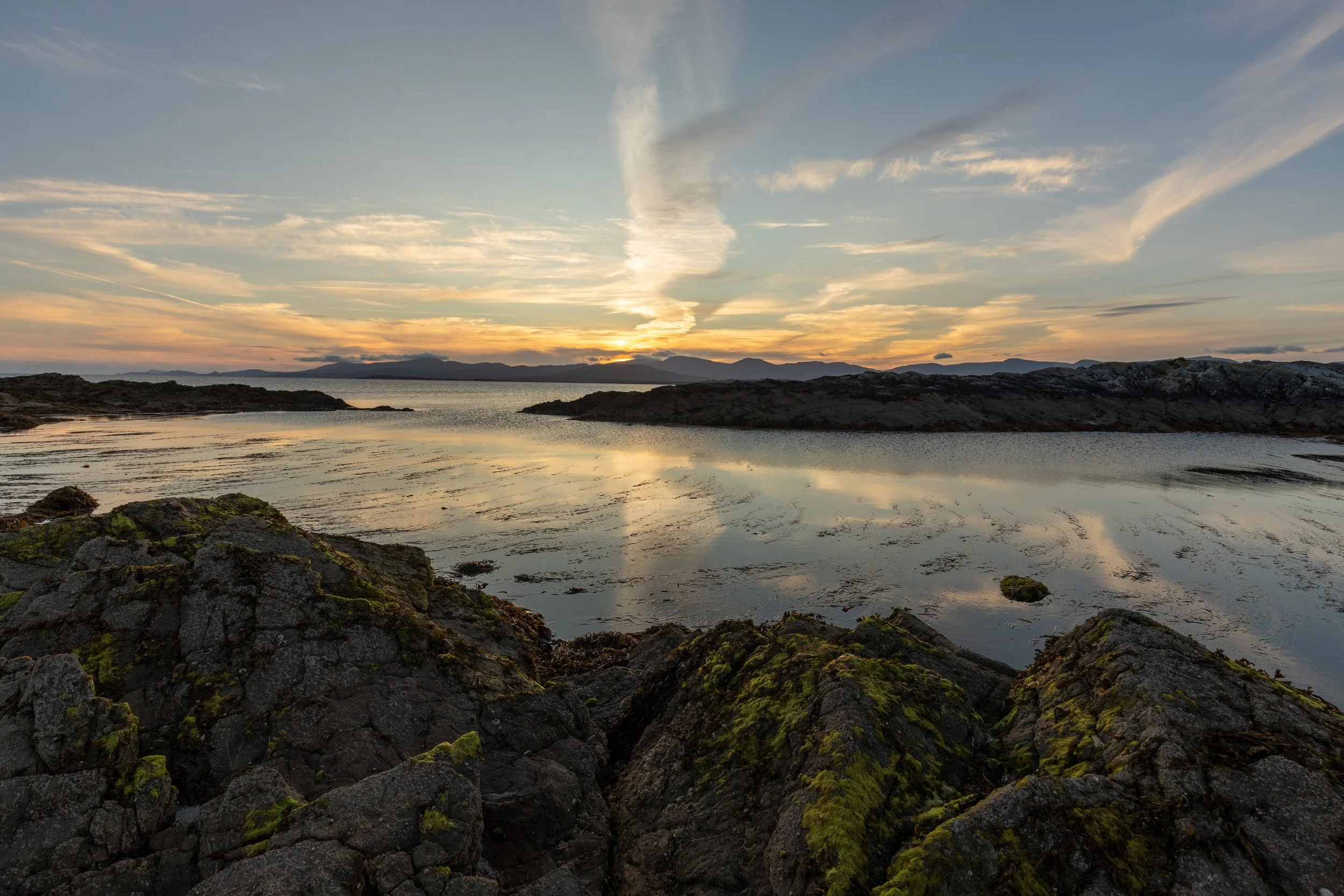
At this stage I was hoping that the clouds would start to pick up some of the remaining light as the sun dropped lower. There were clouds higher in the sky, and if they caught some of the sunset light, there was the possibility that they would reflect in some of the rock pools I had started finding around the location. I moved further across the rocks and came across some interesting pools, so I set up another composition and waited to see whether the light would develop.

Unfortunately, it didn’t really happen in the way I had hoped. I took the photograph anyway, and while I wouldn’t consider it one of my strongest images from the shoot, that doesn’t mean it was a wasted photograph. When you visit somewhere for the first time, part of the process is learning what works and what doesn’t. You are not necessarily going to arrive at a new location and immediately come away with a portfolio image, and I think that is something photographers sometimes put too much pressure on themselves about.
For me, the value of this particular evening was also in working out how the location might photograph under different conditions. I had seen what the low tide exposed, I had seen how the evening light interacted with the algae and I had started to understand where the rock pools were. I now had a better idea of what I might look for if I came back when the tide was higher or when the light was different.
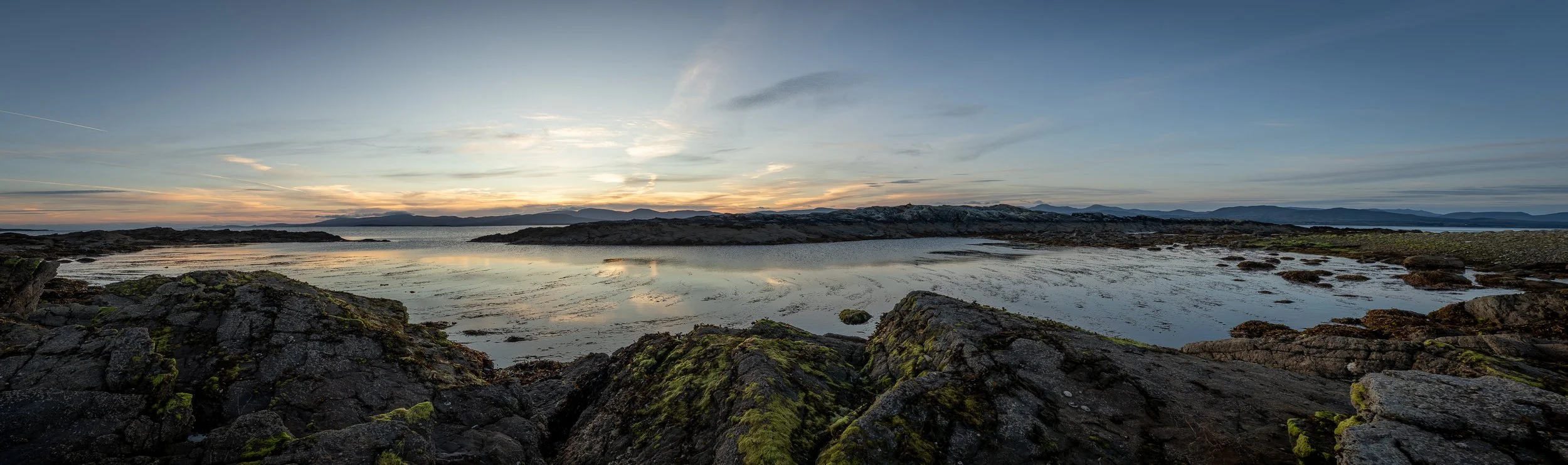
As I continued looking around, Gavin’s challenge came back into my mind. If I was already going to complete the entire shoot without using filters, I thought I might as well take the challenge a little further. Gavin has his own signature style of panoramic image using an X-Pan crop, and while I don’t have the same setup, I thought I could create my own version by shooting a panorama and then using that wider crop during the edit.
I found a composition that I thought could work and captured the scene as a panorama. The idea was to create the wider aspect ratio afterwards rather than simply taking a conventional landscape photograph. It seemed to work reasonably well, and it gave me another way of looking at the scene. Again, I wasn’t trying to copy Gavin’s photograph exactly, but I was using the idea as another reason to try something slightly different.
By this point, however, the light was disappearing quickly. A bank of cloud was sitting on the western horizon and unfortunately it swallowed up the remaining light from the sunset. There was no dramatic finish to the evening and, with the light gone, there wasn’t much more reason to continue shooting, so I packed everything away and headed off.
It certainly wasn’t the shoot I had expected when I left Kenmare. I had gone to a completely new location hoping to find some good compositions for sunset, only to discover that the low tide had exposed a foreground that initially didn’t really interest me. I had to spend some time looking before I started to see the possibilities, and it was the light hitting the green algae that eventually gave me my first proper subject.
That, for me, was probably the most useful part of the evening. If I had arrived at the location and immediately decided that the exposed rocks covered in algae were not worth photographing, I would have missed the first image. Instead, I had to stop looking for the composition I expected to find and start looking at what the conditions were actually giving me. The light changed how I saw the foreground, and once I had identified that, the rest of the photograph became much easier to put together.
The same applied to the rock pools later in the evening. I was hoping that the clouds would catch some of the remaining light and give me reflections, but the conditions didn’t really come together. That photograph may not end up being one that I do much with, but it still has value because it tells me something about the location and gives me another potential composition to consider if I return.
That is why I think there is a lot of value in both revisiting locations and exploring new ones. When you revisit somewhere you already know, you start to understand how the tide, light and weather affect the compositions you have found. You can return with a different tide or different weather and discover that the same location gives you something completely different. When you visit somewhere new, however, you have to react to what is in front of you and that can force you to think differently about your photography.
This shoot was a good example of that. I had no preconceived idea about what I would photograph because I had never been there before, and the low tide immediately made things more difficult. The light then gave me a reason to photograph something that I probably wouldn’t have considered under different conditions. I moved around as the light changed, explored the rock pools and eventually tried something different with the panoramic image.
And then there was Gavin’s challenge.
I had completed the entire shoot without using a single filter, although that probably wasn’t quite the achievement Gavin had in mind when he originally issued the challenge. After all, I hadn’t used a 10-stop filter during 2026 anyway, so avoiding one for this particular shoot wasn’t exactly difficult. Still, I’ll take the win.
There is also a useful lesson behind the joke. Photography challenges can be useful when they make you think differently about how you approach an image. I already knew that I didn’t need a 10-stop filter, but having Gavin’s challenge in the back of my mind made me more conscious of the fact that I was working entirely with the available light and without relying on filters to create the photograph.
In the end, I think that was probably the biggest takeaway from the evening. When you arrive somewhere new, you have no guarantee that the location will give you the photograph you had imagined. The tide might be wrong, the foreground might not work, the light might disappear or the clouds might block the sunset completely. That doesn’t mean there isn’t a photograph there; it just means you might have to spend more time looking for it.
On this occasion, the photograph was in the green algae that I initially hadn’t considered interesting. The low tide had exposed it, the evening light brought it to life and the changing position of the sun meant I had to keep moving to maintain that light on the subject. It wasn’t the type of photograph I had expected to make when I left Kenmare, but that is exactly why I enjoy exploring new locations.
I came away with a few photographs, a better understanding of somewhere I had never visited before and, most importantly, another location that I can now return to under different conditions. I also managed to complete the entire shoot without using a filter, which means that Gavin’s challenge has technically been completed.
So there you go, Gavin.
But here’s the question: who was it exactly that gave you permission to challenge me in the first place :-)