I Went Back To An Old Photography Location…And Got Confronted
When I first started out in photography, I wanted to try as many different types of photography as possible. I wanted to find out what I enjoyed, what I was good at and, perhaps more importantly, what kept me wanting to pick up the camera and go out again.
One of those areas was photographing old and abandoned buildings around Ireland.
Ireland has no shortage of them, and I became interested in finding these places and trying to document what was left of them. A big part of that interest came from the work of photographer Tarquin Blake. His books, including Abandoned Mansions of Ireland and Abandoned Mansions of Ireland II, document many of Ireland’s abandoned houses and the history connected to them. His work was one of the things that showed me that photographing old buildings could be about more than simply finding an interesting subject. There was a story attached to every place.
I photographed quite a few locations during those early years, sometimes on my own and sometimes with my friend Dave. I enjoyed the searching, the walking, the uncertainty of what I would find and the process of trying to work out how best to photograph a building that had already been photographed many times before.
Then I discovered seascape photography.
As many of you reading this will know, seascape photography eventually became the main focus of my work. That is still true today. However, I never completely lost my interest in old buildings. There was always something about finding a structure that had been left behind and trying to record it before it changed any further.
So, when I found myself heading towards Kerry, I decided to revisit that part of my photography.
I wanted to see if I could rekindle that interest and, perhaps, remind myself why I had enjoyed it so much in the first place.
The location I chose was Ardtully House, near Kilgarvan.
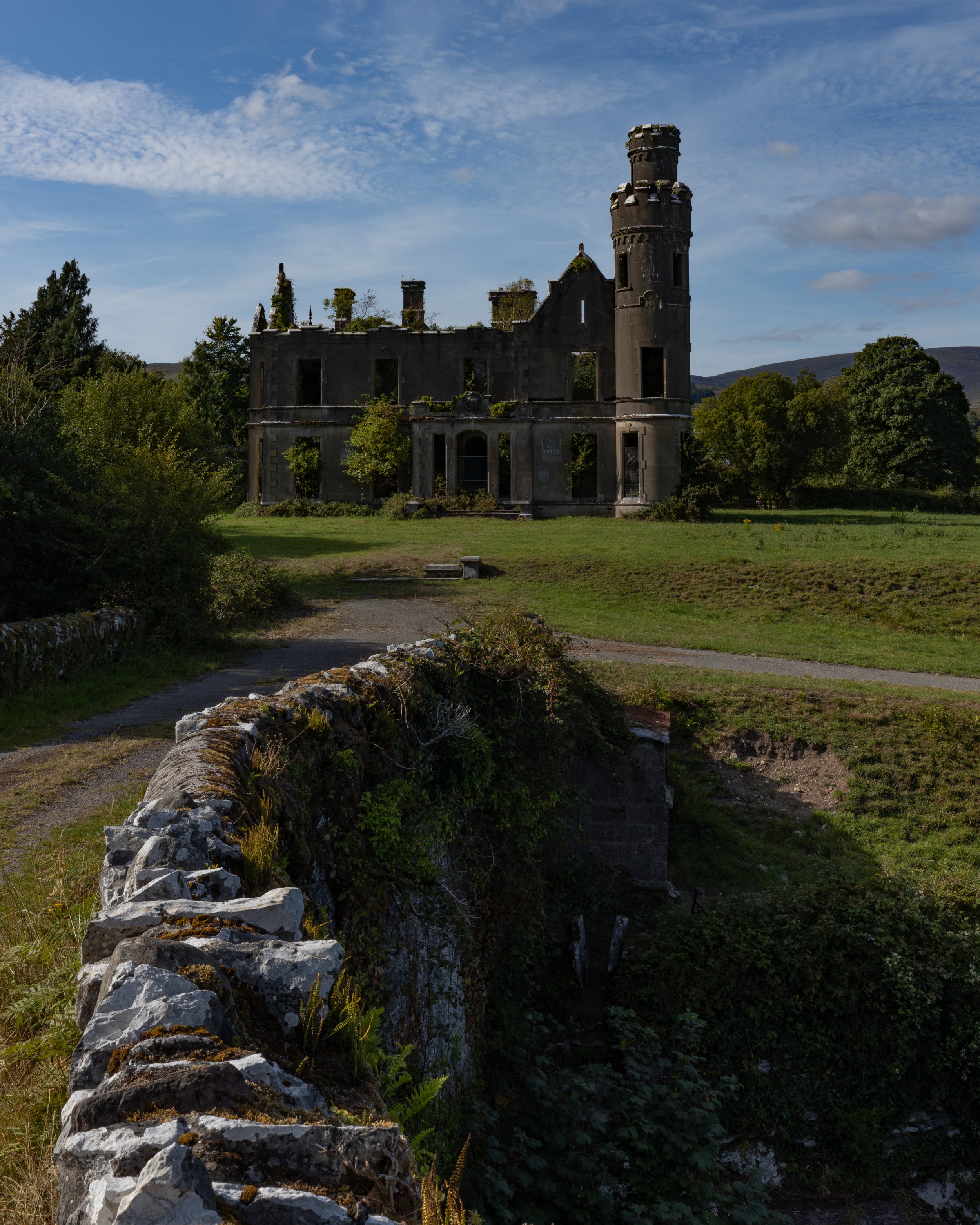
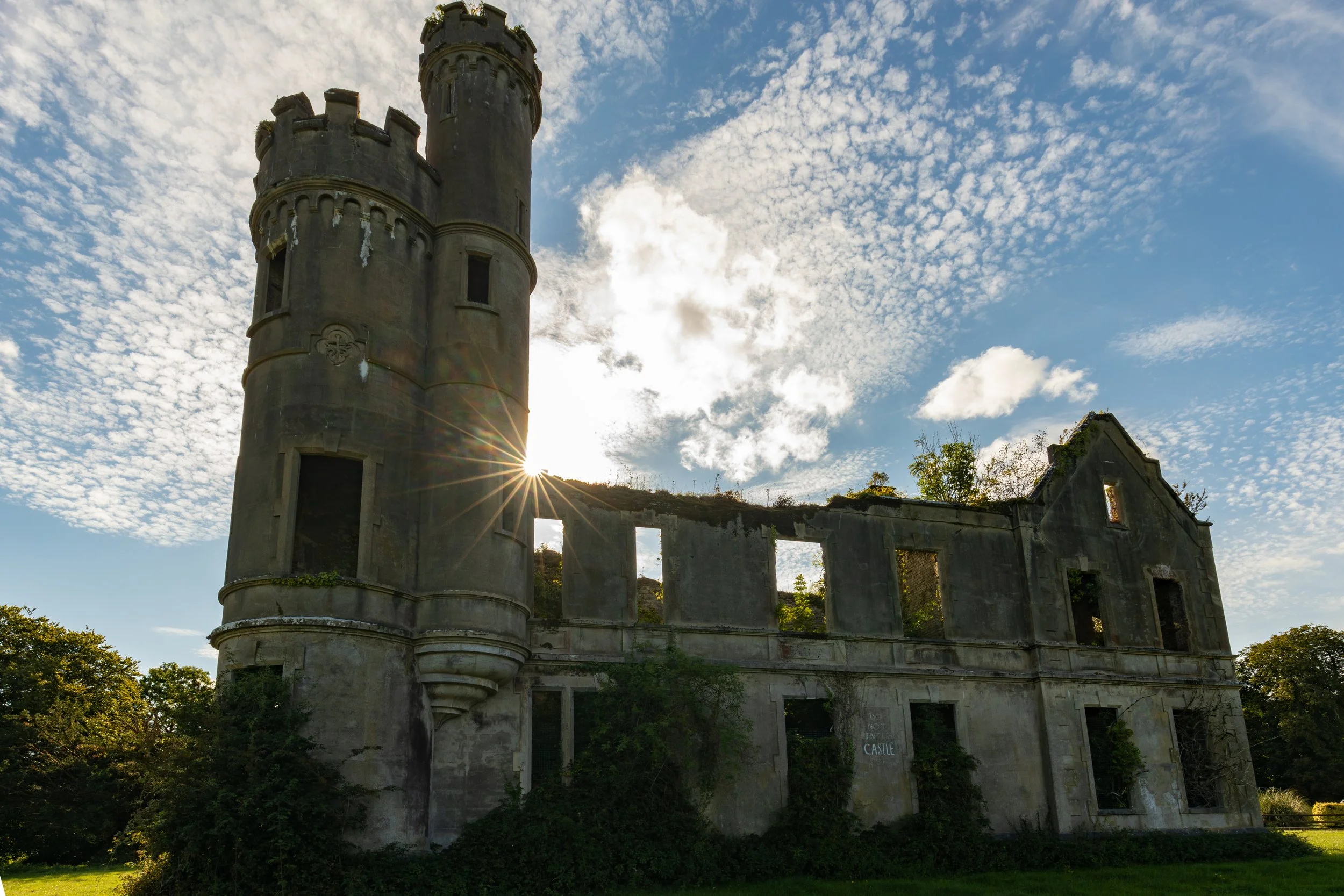
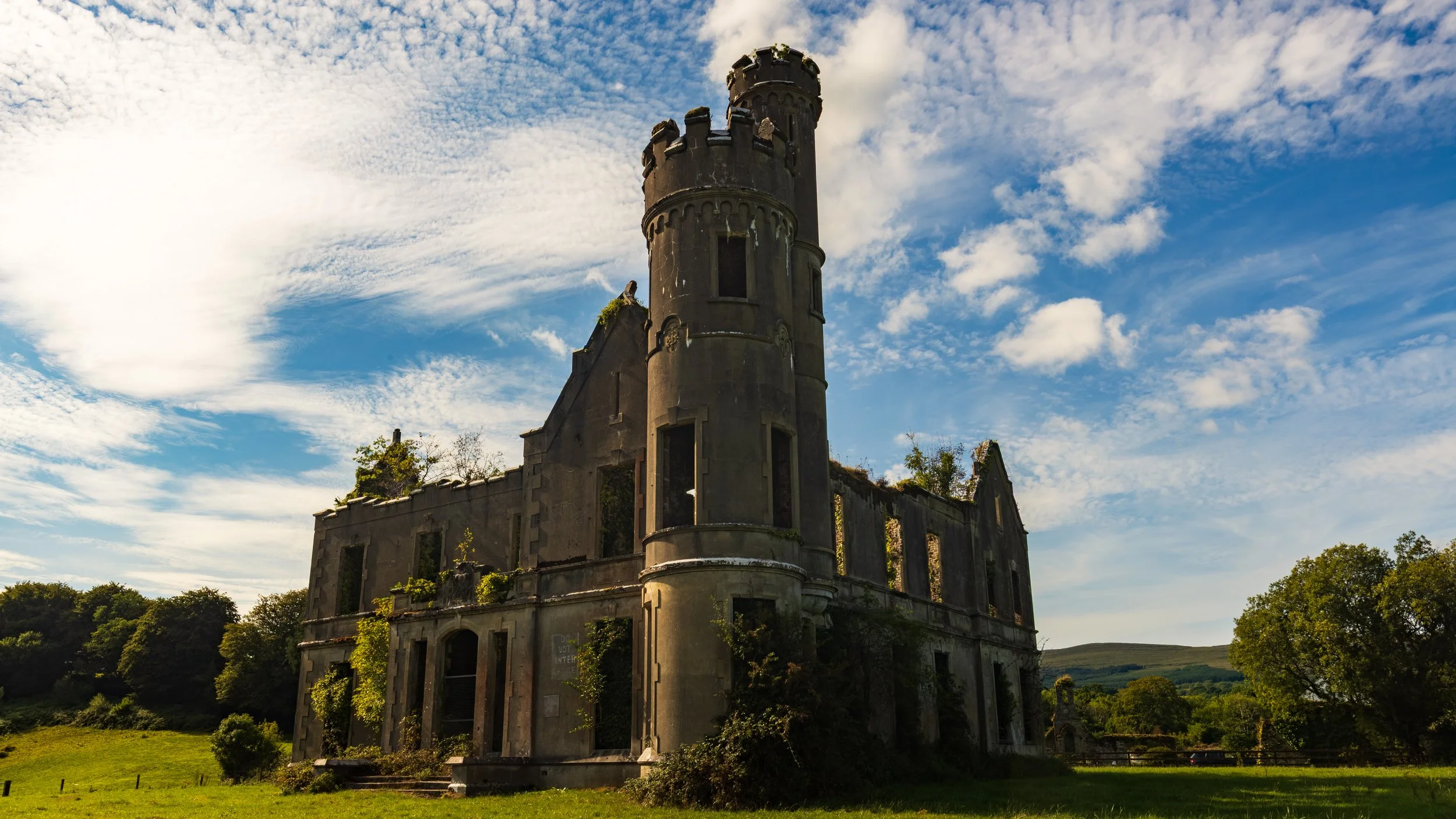
I had visited Ardtully many times before, probably around eight years earlier, and I knew the location well. The building is often referred to as Ardtully Castle, although the structure that now stands in ruins was actually Ardtully House, a Scottish-Baronial style house built by Sir Richard Orpen in 1847. It replaced earlier structures on the site, including an older castle. The house was burned in 1921 during the War of Independence and the ruins remain today.
That history is part of what makes the location interesting to me. It is not simply an old building sitting in a field. There have been several structures on this site, with the history of the location going back much further. The remains of the earlier castle were themselves destroyed during the Cromwellian period, before the later house was built.
As I turned off the main road and followed the smaller road towards Ardtully, the memories started coming back.
I remembered arriving here years earlier with a camera and looking for different angles. I remembered walking around the building and trying to understand how it fitted into the surrounding landscape. I remembered the weather too.
Every time I had visited before, it seemed to rain.
On this particular visit, that was not going to be a problem.
There was no rain.
Instead, I was dealing with harsh midday sunlight.
That is not normally what I would choose for photographing a building like this. I would much rather have softer light, lower contrast and more controlled conditions. But I had not come here to wait for perfect conditions. I had come to revisit the location and see what I could get.
So I started walking.
There were other people around the area, which was another reminder that this was not some completely forgotten location. People were walking around and enjoying the surroundings, and it was clear that the area was still being used by locals and visitors.
I began with some straightforward photographs of the house.
I photographed details from closer distances and then moved further away to see how the building worked within its surroundings. I wanted to make photographs that showed the structure itself, but I also wanted to include enough of the landscape to give the building some context.
Then I moved towards the bridge.
For me, this is the strongest viewpoint at Ardtully.
The bridge gives you a way of looking back towards the ruined house, and it creates a relationship between the foreground and the building. The bridge itself is also part of the history of the location. The old bridge across the Roughty River dates from 1786 and is associated with the Ardtully estate.
This was the photograph I had come for.
I spent some time working out the composition, taking a few different versions and trying to decide how much of the surrounding area I wanted to include.
Eventually, I got the shot.
At that point I could have packed up and left, but I wanted to do something I had done here before.
I wanted to put the drone up.
Aerial photography has changed the way I look at locations like this. From the ground, you see the building from one particular perspective. From above, you can understand how the building sits within the landscape.
I had used a drone at Ardtully on previous visits, so I expected to get some interesting footage again.
I launched the drone and started looking at the house from above.
The aerial view showed the building and its position within the surrounding valley in a way that I could not see from the ground. It was useful for showing the scale of the site and the relationship between the ruins, the river and the surrounding countryside.
Then I noticed someone approaching me.
They were moving quickly.
As they got closer, they started shouting.
“Is that your drone? Get it down immediately. Do you realise this is private property? Who do you think you are?”
I was not expecting that.
The part that surprised me most was the private property issue.
I had seen a private property sign when I arrived. It was positioned beside a sign relating to anglers, and I had interpreted the signs as applying to the access or fishing activity rather than to what I was doing. I had also seen people walking around the area, which reinforced my assumption that it was okay for me to do the same.
Looking back, that was my mistake.
If there is a private property sign, I should not make assumptions about whether it applies to me. I should establish exactly what it means before proceeding.
The drone was the immediate issue, but the bigger lesson for me was about assumptions.
I brought the drone down immediately.
There was no argument and there was no point trying to justify what I had done. I had been challenged, I had realised that I had interpreted the situation incorrectly, and the simplest thing to do was to land the drone and continue without it.
It is one of those moments where you learn something useful.
Even if you think a sign might not apply to you, do not assume.
Ask.
Check.
If you cannot establish that you have permission, do not proceed.
That applies to photography as much as it does to flying a drone.
Once the drone was back on the ground, I continued with the shoot.
The incident had changed the mood slightly, but it did not ruin the reason I had come here.
I was still photographing the same building I had photographed around eight years earlier.
That was actually the part of the day I found most interesting.
Looking at the images afterwards, I could see how much my photography had changed.
The location had not changed dramatically from what I remembered, but I had.
My approach to composition was different. My reasons for making the photograph were different. I was more interested in how the building fitted into its surroundings, rather than simply trying to find a good angle of the building itself.
That is one of the things I like about returning to locations.
You are not necessarily going back to photograph the same thing.
You are going back to see it with the experience you have gained since the last visit.
Eight years earlier, I was still developing my approach to photography. I was trying different subjects and working out what I wanted to photograph. Today, I am much more established as a photographer, but revisiting Ardtully reminded me that my interest in old buildings never really disappeared.
It had simply taken a back seat.
There is also something useful about photographing subjects outside your normal area of work.
When I spend most of my time photographing the coast, I am thinking about tides, waves, weather, light, movement and composition. A ruined building gives me a different set of problems.
The subject does not move.
There is no tide to wait for.
There is no wave to time.
Instead, the challenge is finding a way to make the structure interesting through composition, light and the surrounding landscape.
On this visit, the harsh midday sun made that more difficult, but that was also part of the challenge.
I could have decided that the conditions were not good enough and walked away.
Instead, I worked with what I had.
That is something I try to apply to landscape photography in general. We do not always get the conditions we want, and sometimes the photograph is about working out what is possible with the conditions that are actually in front of us.
It is easy to look at landscape photography online and assume that every photograph comes from perfect conditions.
It does not.
Most of the time, we are dealing with whatever the weather decides to give us. The important part is knowing when to adapt rather than simply waiting for everything to be perfect.
Ardtully also reminded me why I enjoyed photographing abandoned buildings in the first place.
There is the photography, of course, but there is also the history.
The house was built in 1847, replacing earlier structures on the site. The remains we see today are the result of that history, including the destruction of the house in 1921.
That makes the photograph a record of something that has already changed once and will continue to change.
This is probably why Tarquin Blake’s work had such an influence on me when I was starting out. His books are not simply collections of photographs. They document buildings, their histories and what remains of them. That combination of photography and documentation was what first interested me in this type of work.
I did not set out on this trip intending to make some major return to photographing abandoned buildings.
It was simply a decision to stop at somewhere I had photographed before and see what happened.
In the end, I got some photographs, some drone footage, a reminder of an interest I had almost forgotten about and a useful lesson about private property.
Not a bad result from a visit that was never meant to be anything more than a trip down memory lane.
And perhaps I will do more of this.
There are still plenty of old houses, castles, bridges and other structures around Ireland that I have never photographed. Some are well known, others are not.
I am not planning to abandon seascape photography.
But I also do not think I need to limit myself to one type of photography.
Sometimes it is useful to go back to something you enjoyed before.
You might find that you still enjoy it.
You might also find that you approach it completely differently.
For me, that was the real reason for returning to Ardtully.
I wanted to see if the interest was still there.
It was.
And despite the drone incident, the harsh light and the fact that I had photographed the location many years before, I am glad I stopped.
It reminded me that photography is not always about finding something new.
Sometimes it is about returning to something familiar and seeing what you can do with it now.
Perhaps that is something worth remembering the next time you are deciding where to go with your camera.
You do not always need a new location.
Sometimes an old location can give you a completely different photograph simply because you are a different photographer.