The Secret Behind Getting Better at Photography
The idea for this blog post & video actually came from a conversation that had absolutely nothing to do with photography.
A few days ago I was chatting with my youngest son and he asked me a really simple question. He had been outside practising basketball and wanted to know how people actually get good at something. My answer was immediate and honestly pretty basic at first: you just keep doing it. Practice often enough, and over time you improve.
But after the conversation ended, I kept thinking about it.
How often is enough?
How long does improvement actually take?
Why do some people improve quickly while others seem to stay stuck despite owning good gear, watching tutorials, or wanting it badly enough?
And naturally, because photography has been such a huge part of my life for so long, my brain immediately started applying the idea to landscape photography.
The more I thought about it, the more obvious it became that photography improvement is actually very simple in principle, but much harder in practice.
Every single time we take the camera out, we learn something. Sometimes those learnings are obvious and immediate. Other times, they are subtle enough that we barely notice them happening.
Maybe we can learn something about composition.
Maybe we realise why a scene did not work.
Maybe we'd better understand the light direction.
Maybe we can discover how the weather affects mood and atmosphere.
Maybe we learn how tides change the foreground.
Maybe we can learn how to plan a location better.
Or maybe we simply become more comfortable using the camera itself.
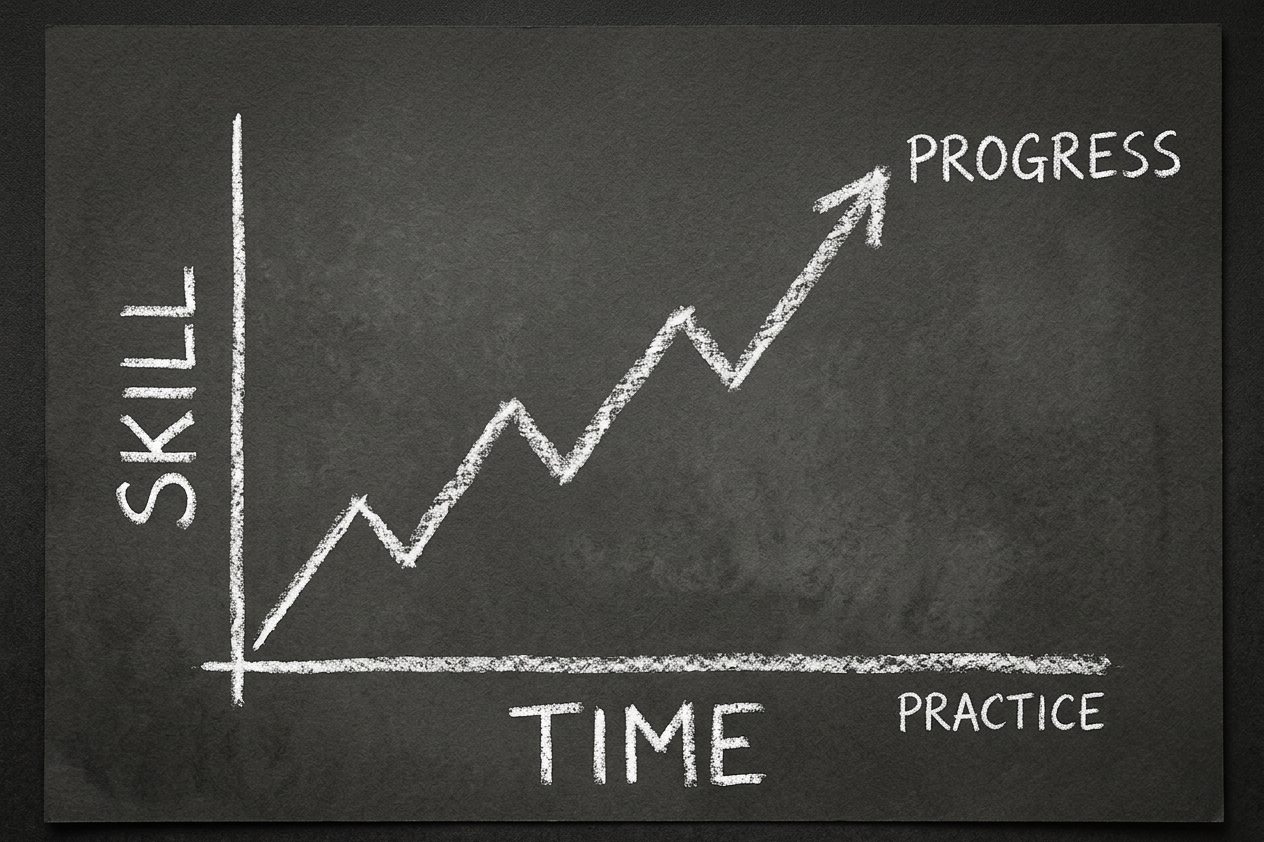
At the time, these can feel like tiny, insignificant improvements, but over weeks, months, and years, those small learnings begin to compound. That is where real growth happens.
Looking back at my own photography journey, every major improvement came through repetition. It certainly did not come from reading about photography alone or watching videos online. It came from standing in the rain, making mistakes, missing shots, getting compositions wrong, arriving at locations too late, and learning from all of it.
Even now, I still make mistakes regularly. The difference is that mistakes no longer feel like failures. They are simply part of the process.
But there is another side to this as well, and I think this is the part many photographers quietly struggle with.
Life gets in the way.
Work happens.
Family happens.
Responsibilities happen.
Weeks can suddenly pass without touching the camera, and then when you finally head back out again, you feel rusty. You second-guess compositions, hesitate more, and sometimes even lose confidence in your own ability.
I realised that this is not usually because someone lacks talent. More often than not, it is because repetition disappeared.
That thought became the real turning point for me.
I started thinking about something else that applies far beyond photography: the importance of having something to look forward to. A trip in the diary, a planned adventure, a date in the calendar, something that creates anticipation and commitment.
Because once something is scheduled, it becomes real.
And when something becomes real, we prepare for it.
That preparation forces action, and action is what drives improvement.
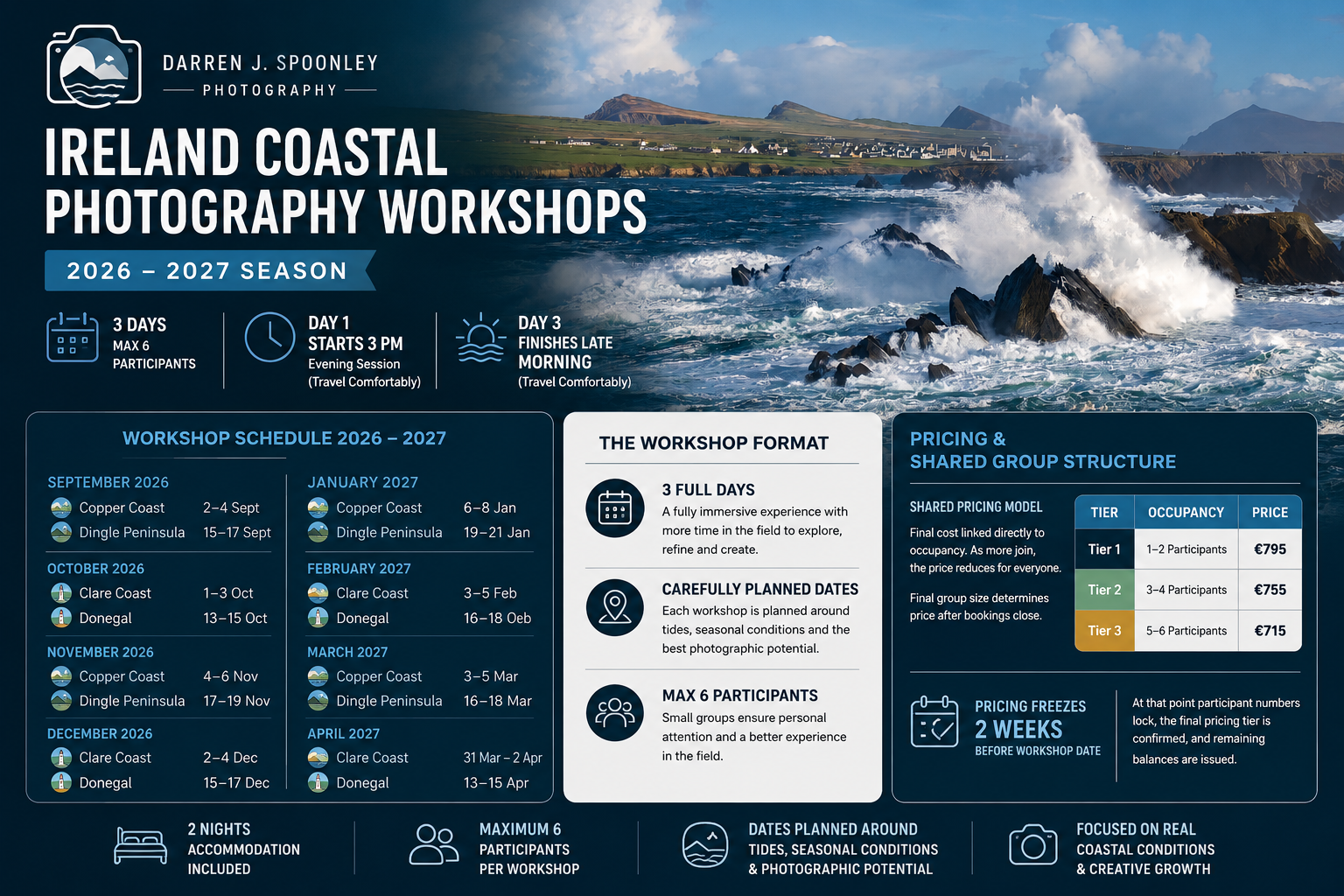
While planning the 2026–27 workshop season, I began reflecting heavily on feedback from previous participants, and interestingly, many of them were describing exactly the same problem.
Some said they struggled to go out regularly because they had no structure or plan in place.
Others mentioned that when they did finally get out with the camera, they simply returned to the same easy location because it was familiar and convenient.
A lot of people also admitted that long gaps between shoots made them feel out of practice, which then affected their confidence and motivation.
That was probably the biggest realisation of all for me.
The photographers improving the most were not necessarily the photographers with the best cameras or the most technical knowledge. They were the photographers who consistently showed up, kept practising, and had some kind of structure in place that encouraged repetition.
That was the eureka moment.
Instead of building workshops purely around locations, I started thinking about how I could create a structure that genuinely helps people improve over time.
That thinking completely reshaped the new workshop season.
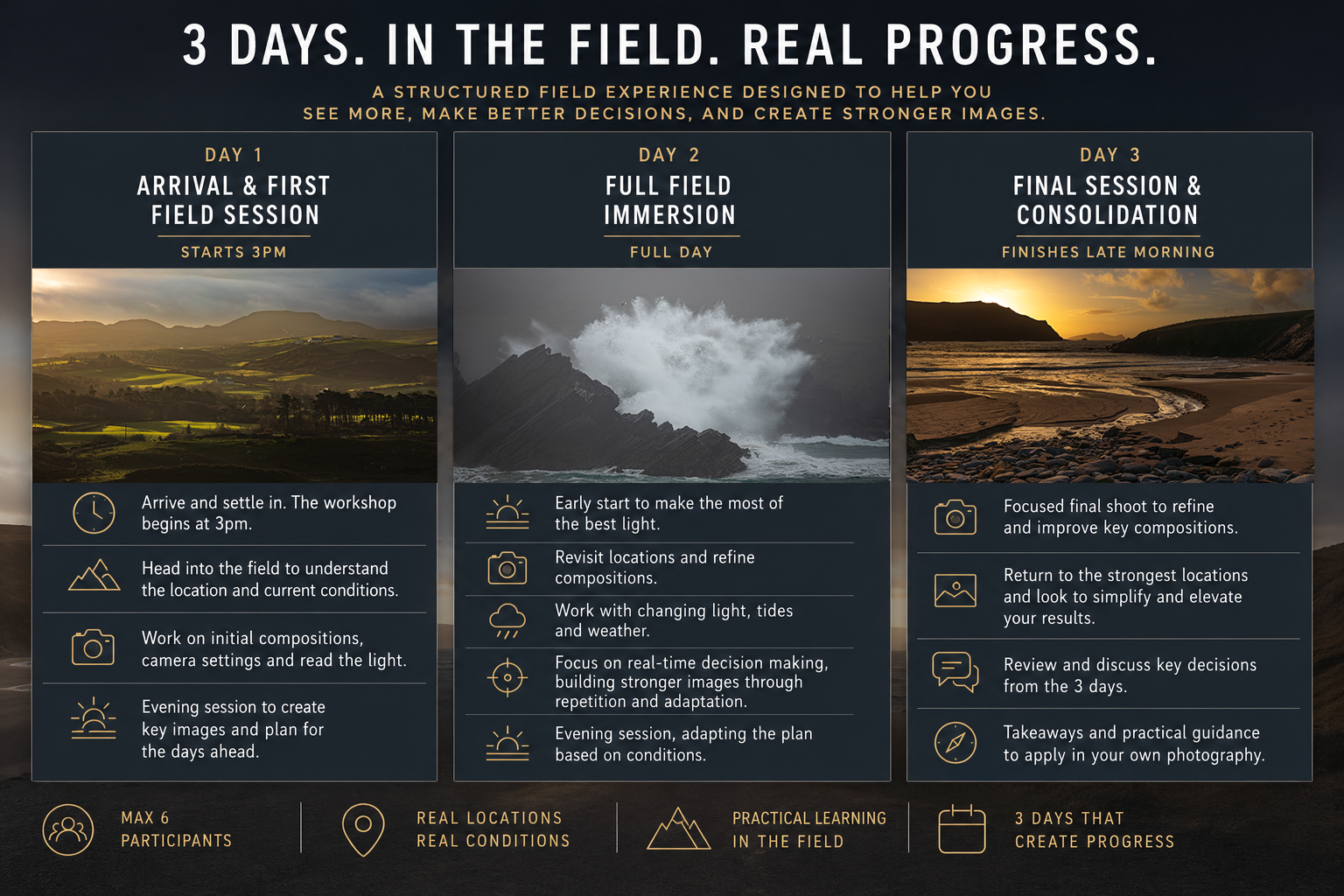
The first major change was moving the workshops to a full three-day format rather than single-day trips. A single day can absolutely be valuable, but three days create something entirely different. Participants settle into the process more naturally, become less rushed, and have time to properly absorb what they are learning.
It also allows for a far wider variety of conditions and scenarios. One morning may bring dramatic storm light while the evening delivers calm conditions and soft colour. Those changes are incredibly important learning opportunities because landscape photography is rarely about perfect conditions. It is about adapting to what is in front of you.
The second major change was creating a full schedule of workshop dates across the season. This gives participants something concrete to look forward to and something they can actively plan around. Rather than photography becoming an occasional afterthought, it becomes an intentional part of the calendar again.
Some locations are repeated throughout the season as well, and that has been done deliberately. Returning to locations multiple times allows photographers to refine compositions, experiment with different conditions, and build familiarity instead of constantly chasing somewhere new. At the same time, there are also completely different coastal locations included throughout the season to encourage creative growth and broaden experience.
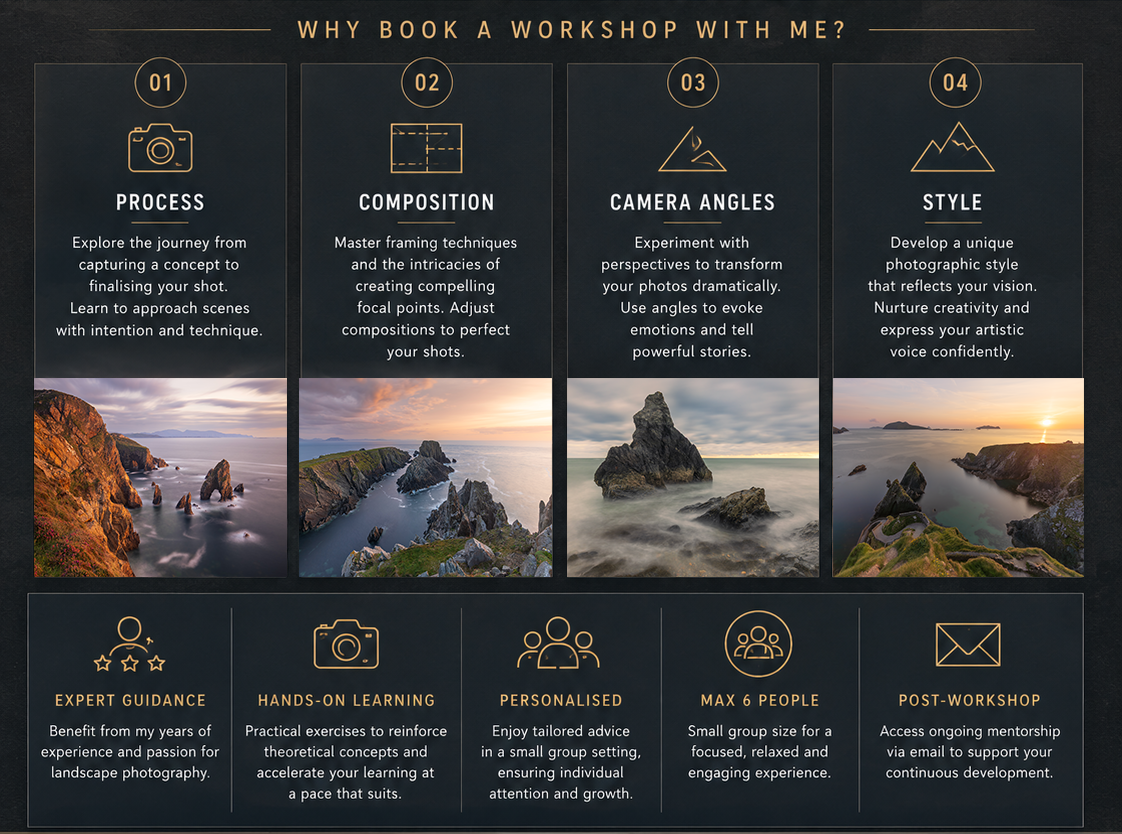
The workshops themselves are still built around the same principles I have always believed in: practical learning, real-world conditions, honest teaching, and keeping the experience enjoyable and relaxed. The goal has never been to simply stand beside someone while they take a photo. The goal is to help people better understand why they are taking the photo in the first place.
That understanding is what creates long-term growth.
One of the most important aspects of the new structure is flexibility. Participants can now book a single workshop as a standalone experience, return to repeat locations throughout the season to refine specific skills, or join multiple workshops across different regions to build a much broader understanding of landscape photography as a whole.
What this effectively creates is progression.
A photographer who joins multiple workshops across the season is not simply attending random trips anymore. They are building continuity, repetition, confidence, and momentum over time. They begin recognising conditions faster, planning more effectively, refining compositions more naturally, and becoming more adaptable in changing environments.
That repeated practice is where the biggest improvements happen.
The pricing structure has also been designed with this in mind. Rather than encouraging one-off experiences alone, the structure rewards photographers who want to commit to longer-term growth and development throughout the season. The more workshops participants join, the greater the overall value becomes, both financially and educationally.
And perhaps most importantly, participants are no longer trying to figure everything out alone.
They become part of a community of people who are all working toward the same thing: improving, creating, learning, and spending more time outdoors with the camera.
In many ways, this video became less about workshops and more about the process of improvement itself. The workshops simply became the natural outcome of that thinking.
Because when I really stripped everything back, the answer to my son’s question was still the same.
How do you get good at something?
You keep showing up.
You keep practising.
You keep making mistakes.
And over time, those small improvements compound into something much bigger than you ever realised at the beginning.
So if this way of thinking about photography resonates with you, I’d genuinely love to have you join me for part of the 2026–27 season. Whether it’s one workshop to reignite your creativity, repeat visits to fine-tune your skills, or multiple immersive trips across Ireland’s coastline, the entire structure has been built around helping photographers grow through experience, repetition, and real-world learning.
Full workshop details, locations, dates, and booking information are linked below.