
What the World's Most Iconic Landscape Photography Locations Have in Common
For many photographers, the search for better images often begins with the search for better locations.
It's easy to understand why. Social media feeds are filled with photographs from famous destinations such as the Cliffs of Moher, the Dark Hedges, the Isle of Skye, Glencoe, Snowdonia, the Dolomites, and the Giant's Causeway. These places have become synonymous with landscape photography, attracting thousands of photographers each year hoping to capture their own version of a scene they have admired online.
The assumption is often that these locations produce strong photographs simply because they are famous. However, after years of photographing landscapes throughout Ireland and beyond, I have come to a different conclusion.
The locations themselves are only part of the equation.
What makes these places successful photographically is not their name or reputation. It is the collection of visual characteristics they possess and how photographers use those characteristics to create compelling images.
Once you begin to recognise these patterns, your approach to photography changes. You stop searching exclusively for iconic destinations and start identifying photographic opportunities wherever you happen to be.
Looking Beyond the Location
The most successful landscape photographs tend to share several common traits.
They often contain depth, created through layering and perspective. They rely heavily on quality light, particularly during the hours around sunrise and sunset. There is usually some form of contrast between colours, tones, or textures. Most importantly, there is often a sense of simplicity, with a clear subject and minimal distractions competing for attention.
These principles appear repeatedly across many of the world's best-known photography locations.
Understanding them can be far more valuable than simply knowing where a photograph was taken.

The Cliffs of Moher and the Importance of Structure
The Cliffs of Moher are frequently photographed because of their scale, but scale alone does not create an effective image.
What makes the location particularly strong is its natural structure. The cliffs provide clear layers within the frame. A foreground element may consist of grass or the cliff edge itself, while the cliffs form a midground that guides the eye through the composition before leading towards the distant ocean and sky.
This layering creates depth and gives the viewer a sense of place.
The important lesson is that this approach can be applied almost anywhere. A local hillside, farmland, coastal path, or valley can all be photographed using the same foreground, midground, and background structure.
The visual principle remains identical regardless of the location's fame.

The Dark Hedges and the Power of Direction
While the Cliffs of Moher demonstrate depth, the Dark Hedges showcase another important principle: direction.
The avenue of trees naturally forms leading lines that guide the viewer's eye through the frame. The success of many photographs from this location comes from how effectively those lines direct attention.
Leading lines are not unique to tree tunnels. Roads, rivers, fences, pathways, shadows, and even rows of rocks can perform the same function.
The key is learning to position yourself so that these elements lead the viewer exactly where you want them to look.
When photographers begin to recognise leading lines in everyday scenes, new opportunities appear almost everywhere.

The Isle of Skye and the Role of Atmosphere
The Isle of Skye is renowned for its dramatic weather as much as its landscapes.
Mist, low cloud, changing light, and rapidly evolving conditions frequently contribute to the strongest images made there. These conditions simplify scenes, add atmosphere, and help separate different elements within the landscape.
Many photographers wait for clear skies and predictable weather. In reality, some of the most memorable photographs are created when conditions are less straightforward.
Fog can remove distractions. Rain can add mood. Low cloud can simplify a busy scene.
The lesson is not specific to Skye. These opportunities exist in local landscapes throughout the year if photographers are willing to embrace them.

Glencoe, Snowdonia, and Creating Separation
Locations such as Glencoe and Snowdonia demonstrate the value of layering on a larger scale.
Mountain ridges, valleys, and changing elevations create natural separation between different parts of the landscape. When combined with directional light, these layers become increasingly distinct, giving photographs a sense of depth and dimension.
This effect does not require mountains.
Even modest hills, rolling farmland, woodland edges, and coastal headlands can create similar results when photographed under suitable lighting conditions.
The principle remains the same regardless of the scale involved.
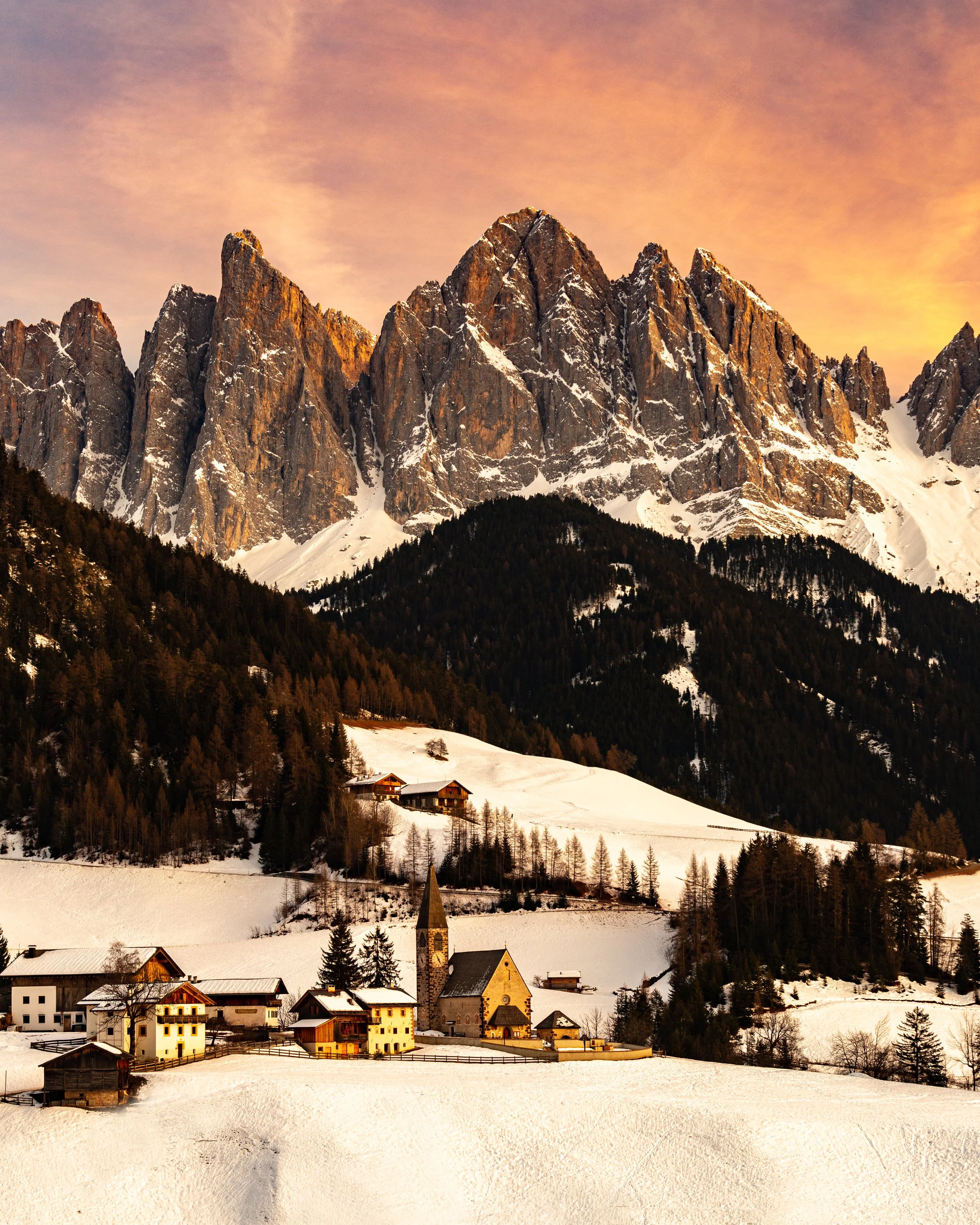
The Dolomites and the Value of Contrast
The Dolomites provide an excellent example of how contrast strengthens a composition.
Sharp peaks often rise above softer foregrounds. Warm sunlight illuminates rock faces while cooler tones remain in shadow. These differences create visual separation and help guide the viewer through the image.
Contrast can take many forms.
It may be the difference between rough and smooth textures, warm and cool colours, natural and man-made elements, or light and shadow.
Photographers do not need mountain ranges to apply this principle. A simple contrast between rock and grass, water and land, or an isolated structure within a natural environment can create similar visual interest.

The Giant's Causeway and the Importance of Patterns
The Giant's Causeway highlights another often overlooked element of landscape photography: pattern.
The distinctive basalt columns create repetition, rhythm, and texture. These qualities encourage viewers to explore different areas of the frame and engage with the image for longer.
Not every successful landscape photograph requires an expansive vista.
Some of the strongest images focus on smaller details, abstract patterns, or repeating shapes. These opportunities can be found in coastal rocks, sand formations, woodland floors, water movement, or even urban environments.
Learning to recognise pattern can significantly expand a photographer's creative options.
The Shared Principles Behind Great Landscapes
When examining these iconic locations collectively, a clear pattern emerges.
They all rely on a combination of depth, light, contrast, simplicity, atmosphere, structure, and pattern.
These are the qualities photographers should be actively searching for when building compositions.
A location does not need to possess all of them. Often, finding two or three of these elements within a scene is enough to create a strong photograph.
The location itself becomes secondary.
Applying These Lessons Locally
One of the most practical exercises photographers can undertake is to intentionally explore local landscapes using these principles as a guide.
Rather than searching for dramatic scenery, look for depth. Look for leading lines. Pay attention to changing weather conditions. Search for contrast between different elements and simplify the composition wherever possible.
Tools such as Google Earth can help identify potential viewpoints before arriving on location. Arriving early provides time to evaluate compositions and respond to changing conditions.
In many cases, the difference between an average photograph and a strong one comes down to observation rather than geography.
Why Location Is Only Part of the Story
The photography industry often places significant emphasis on destinations. Workshops, guidebooks, social media posts, and travel content frequently focus on where photographs are made.
What receives less attention is why certain photographs work.
Understanding the underlying principles behind successful landscape images provides photographers with far more creative freedom. Instead of relying on a shortlist of famous locations, they gain the ability to recognise opportunities in places that others may overlook.
The result is not only stronger photography but also a more rewarding creative process.
The next time you find yourself admiring an image from the Cliffs of Moher, the Isle of Skye, Glencoe, or the Dolomites, look beyond the location itself.
Study the depth. Examine the light. Notice the contrast, atmosphere, and composition.
Chances are, those same ingredients already exist much closer to home.